
Competencies
Reflection on the Beginning…
Over a decade into my career and I feel like the time has gone so quickly! I still remember being a new graduate music therapist and my programs being full of enthusiasm and insecurity.
So much of my learning as a student, even though I did practical placements, was theoretical or case specific. While many allied health students graduate with a strong understanding of basic approaches and theories, we enter the workforce in the first or second stage of competence.
It is important to consider that when you work in healthcare you are working with people, and they do not follow a script or a manual.
Reflecting on my approach, as a new grad I was bouncing between the first and second stage: I had what I believed to be good intuition, but my analysis was frequently limited by what I did not know.
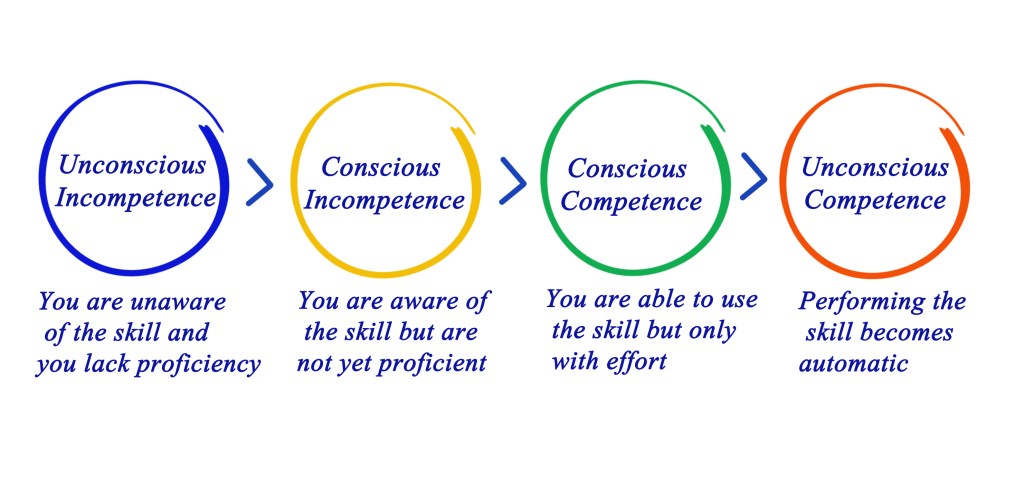
Over the years I have practiced, studied, developed, reflected, and arrived at a place of security in my approach, and still a lot of enthusiasm! I believe myself to now be operating in the fourth stage; engaging with clients in an intuitive and knowledgeable mindset, and my clients reporting feeling safe, validated, and supported by my approach.
However, it is important to continue reflecting on my work, as there is always something else to learn and a skill that still requires effort to execute. Which is why I love attending training, seminars, information sessions, and continuing my education. Below are a list of experiences and achievements I have earned during my time.
Achievements
Registered Music Therapist
Upon completion of my Master of Music Therapy in 2014, I was required to pass the Australian Music Therapy (AMTA) Registration Exam to gain entry into the AMTA and become a Registered Music Therapist.
Music therapists are allied health professionals, but the AMTA is not a member of the Australian Health Practitioner Regulation Agency (AHPRA), choosing to be its own independent agency. Instead, we are a member of the National Alliance of Self Regulating Health Professions (NASRHP), which models its standards after AHPRA.
To keep my registration I need to complete the following:
- Log 20 hours of Continuing Professional Development every 1 year
- Log 1000 hours of Recency of Practice every 5 years
- Log 5 hours of Supervision every 1 year
- Abide by the AMTA’s Regulatory Standards as set out in their Code of Professional Conduct Guide, and NASRHP’s Best Practice Regulatory Standards
My ongoing registration means that I can legally practice as a music therapist in Australia; privately and under the NDIS. This means that if you come across someone claiming to offer music therapy but they are not registered with the AMTA, then they are not considered a qualified music therapist in Australia.
If you’re interested in understanding more about music therapy or the AMTA, then please feel free to follow the links in the Footer, or go to my website.
Professional Supervision – Successful Supervision
I completed a professional supervision course in 2022 over 5 days. I learned the subtle yet distinct differences between being a therapist and being a supervisor, which impacted significantly how I approached my work in both areas, but also how I processed information from different people. My thought patterns shifted to consider individual capacity of the other party in a more significant way, which produced positive results in my work.
‘Supervisor’ has a different meaning in different industries, so I also go by ‘mentor’ and ‘executive coach’ depending on who I’m working with.
Leading Edge Program – Women in Leadership Australia
Also in 2022 I completed a 6-month long leadership program for women who were coming into leadership roles. I took the course with a group of competent and brilliant women, who I was able to learn a lot from even though we were in very different careers.
It covered an array of structures and frameworks, including conflict resolution, team leading, project management, compassion, communication, and many other areas that people moving to leadership roles would be required to know.
Although it was very corporate focused, I was able to learn a lot about myself as a leader, as well as how to manage others. I also learned how those in more corporate offices operate, which gave me helpful insights into companies I market and advocate toward, including funding bodies.
Dialectical Behaviour Therapy Intensive Course – Anglicare
In 2016 I worked as a Wellbeing Facilitator at Anglicare for 12 months. It was a very educational time and I was fortunate enough to complete a two-day intensive DBT course, as we delivered the course to our mental health participants.
I was very fortunate to have attended this training and delivered the program, as it taught me a lot of useful psychological skills that I continue to bring to my practice, and I was able to observe and work with some truly phenomenal mental health clinicians, learning so much from experiencing how they worked with participants.
My own practice is quite eclectic; using multiple therapeutic frameworks to provide a holistic person-centered and identity-driven best practice, and DBT has provided me with a strong foundation for mindfulness practice and emotional regulation.
Applied Suicide Prevention Skills Training
Provided me with the knowledge of how, why, and when to communicate with people who had suicidal ideation.
Altered my perception of suicidal ideation and reinforced having a non-judgmental approach, improving my capacity to be more confident and supportive of people when those hard conversations are needed.
Experiences
Supervising and Mentoring Students and Contractors
My first student was a high school observation student and although they were lovely, I was terrified. It seemed so strange that someone wanted to observe me! As I had been the only music therapist in the Central Queensland area, not many professionals had seen me work, and certainly no music therapists. My Imposter Syndrome was high and I was hesitant to assign any jobs or research for this person, having not had the opportunity to delegate before.
Compare that to my latest experiences of supervising a Masters student in their final placement, mentoring a music therapist in how to start a business, and putting together packages and resources for people. I would say I’ve grown quite a lot in my capacity, skills, and passion for supervision.
PD and Online PD Coordinator – AMTA QLD State Committee
I began as the student representative while I was studying, and remained on the committee for 7 years.
A pivotal time in my life, as I was just entering the field and was very keen to make an impact early on. I was part of the design and execution of PD events for all RMTs in QLD and pioneered what would eventually become AMTA’s online PD platform ‘In Tune’.
Information Sessions, webinars, and seminars – Various attendance and presentation
One of the areas that I had to upskill in was presenting and advocating. Now, I find great joy in being able to show others how beneficial I believe music therapy can be, and have been able to present this knowledge to schools, funding bodies, community organisations, local councils, at a small business expo, within an allied health network, at an international music and medicine conference, and every day with my clients and their supports.
I have attended multiple AMTA Annual National Conferences since I became an RMT, even presenting at two of them about my lived experiences as a student and as a neurodivergent therapist.
I have also attended multiple workshops such as neuro-affirming, NDIS, supervision, mental health, first aid and CPR, managerial, budgeting, and superannuation.
It’s always important to continue seeking education and knowledge, especially for populations that will have a great impact on your work.
And you get a nice certificate each time as well.
 Eliza Stubbs ePortfolio